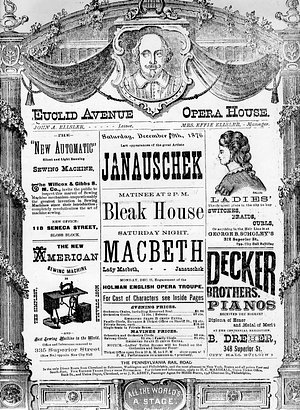
I went to see this last night. I want to say things about it, but not quite yet.
Tuesday, January 13, 2009
Thursday, December 4, 2008
Shakespeare and the Pink Panther
My nine year old daughter has recently taken to watching old cartoons. I think she prefers them to the contemporary stuff (well, except for The Mighty B which is about an adorable nine year old blonde girl who is funny, imaginative and a slight misfit- so she's pretty much watching a cartoon about herself). So, one of the shows she's been enjoying is The Pink Panther (which also shows The Ant and The Aardvark featuring John Byner doing impressions of Jackie Mason and Dean Martin as the two main characters). I loved The Pink Panther cartoons as a kid. I'm still facinated by them. For those of you who don't know them or don't remember- they're cartoons that are completely without dialogue.
Anyway, it got me to thinking about directing Shakespeare. I think I like to approach a production of Shakespeare like it's a Pink Panter cartoon. That doesn't seem to make any sense, does it? I mean, here is the most verbal word-lovin' playwright in the history of the English language. But, I like to try and tell the same story that's being told with language- and tell it visually simultaneously. It's like they say about political debates on TV- if you watch them with the sound turned off, you have the same reaction as the people who have the sound on- you know who "wins."
That's what I like to do- stage a production that you could watch without the sound on and still follow the story, follow the mood and know what's going on. As my friend Tami Moon pointed out- you can have a very strong emotional reaction to opera without understanding a word of Italian (or German). I think that in theater, you can parallel that visually- you can have the same reaction to the plays if the visuals are strong enough- and I'm not talking about striking visuals. I mean, you can put a pyramid on stage or fireworks or a giant llama, but that might not do anything to further the story.
You know, I'll confess, it's what I don't like about The Lion King (the play, not the movie)- the visuals are incredibly striking- I mean, wow! But, they seem to function independently from the emotion of the play.
I'm really speaking in a narrative sense even more than in a thematic sense. That's why I can't stand when I see a play where people are just standing (or sitting) in one spot on stage for a long period of time. What does that do except place the play (visually) in a standstill? It just seems like a waste of the resources of theater. It's like having a giant 30 foot platform on stage and never using it.
Also, I heard my daughter say "oi" yesterday. That cracked me up.
Monday, December 1, 2008
Maccers
We remounted our production of Macbeth. Originally this production was built to concentrate on the intimate relationships between the very human beings in the play- it was built to fit a small black box theater. Last year, we also adopted it to play very large theaters for three performances and then we, well, improvised our way through a “lights on” performance in a big caverny gymnasium at a maximum security prison.
This year, we performed the play environmentally/progressively at the “haunted” ruins of the PFI. Later we performed it at a 1,000 seat auditorium. I was satisfied in a lot of ways about these two latest incarnations, but this particular production is starting to show its wear.
When moving the production outside, we tried to recreate the production as a mood piece with a smattering of fun interactive moments. I think the interactivity allowed the play to retain its intimacy, but it really became another piece - sometimes I thought successfully, other times it was…well… sloppy. Then, by the time we brought the production back to a large indoor theater, the piece was starting to look like a stretched out suit.
Actors don’t always recognize this kind of wear and tear on a production. Often they may play rhythmically with their performances – making it feel pretty good for the actor, but not conducive to a tight performance. Also, I find that (like in long runs) actors often revert to the original approaches they had to the roles. The stuff that appeared at read-through and early rehearsals that the director/actor team works so hard to change reappears. Add to the fact that we moved this piece around for different audiences, different experiences and even with different results in mind, it's no wonder this thing started getting a little stretched out of proportion.
Also, I think shows ought to be built for where they are being performed OR they ought to built to tour- so there’s a flexibility in the direction of the production itself. I loved working on this Macbeth. I thought it was very satisfying and I enjoyed working with the artists associated with it, but, by the end, I really felt that it needed to go back into the shop for a couple of weeks.
There may be some pressure to take this thing out, dust it off and put it up again someday. You know the Macbeth is popular! I hope that, if that’s the case, I remember that it needs some refurbishing.
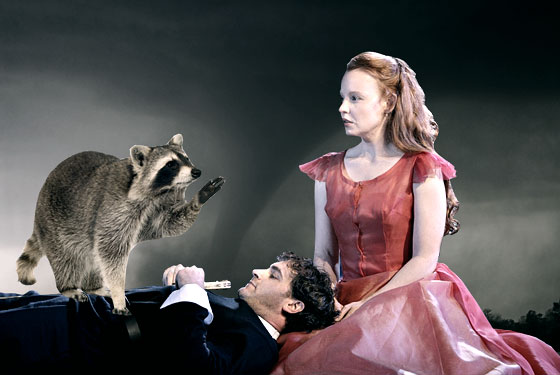
Thursday, October 30, 2008
Shakespeare That I Should Have Hated
I went to a production of one of the history plays last night. There was so much going against the production that I should have hated it. The set was kinda “clichéd modern Shakespeare unit set.” The costumes often had those kind of frayed edges that old clothes never have- only costumes that have been torn to look like they’re frayed. The staging was uninspired – you know, Kings stand in the same place for long periods of time talking and little else. The leading actor was all wrong for the part and some of the actors were guilty of “Shakespeare as performed by flight attendants.” You know, where they point to everything that they’re talking about so that you have a clearer understanding of where the sun is, where the prince just exited or how the flotation devices work?
But it was great- and you know why? Because the actor playing Falstaff was wicked awesome. That’s all it took (oops, I guess I just gave away what play it was). It was just such a lovely performance in, what I consider to be, one of the hardest roles to play. It’s so easy to play the universal symbol of Falstaff (or Puck or Stanley Kowalski or any number of iconic roles) rather than as a person. It's kina like Santa- isn't it? Instead of actors connecting their own humanity to that of the character, they tend to put on the Falstaff suit and just play this kind of “roly poly” (my friend Theresa chose those perfect words) guy that laughs a lot while slapping him tummy. Not this actor. He gave a very sweet “honor” speech. He was funny, warm and just great.
There were other good performances too and, rhythmically, the director got it right too. But usually I don’t believe that a couple of good performances can make a satisfying production- but in this case, I was wrong. Maybe the director did such a good job with the arc of the play that it could withstand some less than perfect elements.
Or maybe that actor was so damn good that it didn't matter about anything else.
Wednesday, September 10, 2008
A Quick Thought
Just a quick thought about the notion of the freedom to experience art. My Father (who is a seriously smart guy, historian, former actor, sailor, curriculum developer, etc.) and I went to the Carnegie International Art Show about ten or fifteen years ago. One of the exhibits was in a small gallery- it was a piece created by John Cage and someone else (I don;t remember the other person). Anyway, the piece consisted of several three dimensional objects in a large room. Every day, a computer would randomly generate the placing of the objects within the room. It would then change every day. Well, to my surprise, my Dad looked at the piece, read about it and then entered the room and moved one of the objects to another location in the room.
What does that do to the piece? Obviously it changed it. But, did he vandalize it? Did he enhance his own personal experience? How did his personal experience enhance the way other people experienced it? To this day, I am somewhat scandalized and inspired by that event.
I think about that every once in awhile.
Friday, August 8, 2008
It's A Fine Line...

I was so annoyed at a rehearsal back in the mid-nineties that I once gave the note "it's a fine line between funny and retarded." As with many of my "notes", I believe the actors sat blankly- confused, annoyed and probably feeling(rightfully) superior.
I had an interesting conversation with my friend Nathan Thomas about the value and need for risks amongst artists. Well, to be honest, it wasn't as generic as "artists," it was a conversation about the value and need for risk amongst small professional Shakespeare companies. Okay, it was actually OUR small professional Shakespeare company.Risk is key, isn't it? If you're not trying to try something a bit risky or new, why bother- especially ESPECIALLY (watch out- I went to all caps)when it comes to Shakespeare.
Many Shakespeare companies have a mission that pretty much amounts to "providing our community with the best live productions of Shakespeare as we can muster." There's something to be said about that, right? If our culture worships the God of Shakespeare, mustn't we allow our community to experience it as designed- live on stage? And what's wrong with attempting to do the best job we possibly can?
But I'm hoping that the Chesapeake Shakespeare Company does more than that. We should be a company based on ideas, not individuals. I think we started this company with the idea that performances of Shakespeare are often uninteresting and disconnected to the words. I know we started CSC because we thought most productions of Shakespeare were boring.
So risks are good- right? I've always said my work is defined more by what I don't like than by what I like. I also don't like pretentious boring psuedo-avant garde rehash. I'll never forget a conventional production I saw of Ubu Roi performed as a theater's "Experimental Theater" production. yeah, let's do something one hundred years old and call it experimental. It seems to me most "experimental theater" is mostly ideas that are at least 30 years old. Almost as awful as staid, conventional, unimaginative art is stuff that claims to be risky or avant garde or innovative, but is really just loud or unfocused or includes brief glimpses of nipples.
A buddy of mine in Minnesota said about me that I was either the straightest unconventional person he knew or the most unconventional straight person he knew and he couldn't decide which. I proudly wear that description of myself but also my work as well. That's what I want- work that doesn't fight convention but stretches the limits of that convention. But, it's a hard idea to communicate to collaborators. Often time actors, designers and other artists mistake my working within the convention with hostility to experimentation- which I don't believe is true. Others limit themselves with no help from me. No surprise there. We ask artists (especially actors) to take risks and audiences often only evaluate them for the work- because they might not know what a director does. So actors get all the blame or all the credit for innovation. Naturally they are going to be a bit reluctant to try new things.
Also, as Artistic Director, I see our work as a continuum rather than a series of individual pieces. So, if one play is conventional it may be a stop along a journey that leads to innovation. But, when you're in the one production, it seems like the production is entirely conventional and....
But, the notion that "risk is good" is something that I need to do a better job of communicating to my company- and it will require more buy-in from company members.
Tuesday, July 8, 2008
Okay, So What Now?
I think I may continue this Blog even though the Shakespeare crammin' is over. I sort of like it- if only because it gives my friends many more opportunities to mock me and what could be wrong with that?
I might still try and see Twelfth Night- I like the idea that the play is set in New Orleans. I think that's appropriate. But, there's a lot of stuff going on this weekend- so I'm not quite sure.
Other upcoming Shakespeare performances:
King Lear at the American Shakespeare Center. I may wait until the Fall, because it starts running with Richard II in October. Also, David Muse is directing an all-male Romeo and Juliet at the Shakespeare Theater in September. It could be interesting- or it could be annoying.
My friends James Ricks and Steve Beall are both in the Folger's Henry IV, Part One- so I will definitely be there. I am a big fan of both of those guys.
I really should go see a Rude Mechanical's show. I will, I promise. But, they're doing Julius Caesar this fall. I just can't get behind that play. I really can't. They're also doing Coriolanus (which I much prefer to Julius Caesar) this summer, but during my vacation. Same thing with Richmond Shakespeare's Henry IV, Part 2. Wow, who does that? rats. I'll miss it.
I do want to go on a pilgrimage to NYC to see a show at the Public. The more I do this, the more I think my hero might be Joe Papp. I love the idea that he took Shakespeare out of the hands of the experts and into the hands of everyone. My favorite story about him was his first performance in Central Park happend because he was doing Shakespeare on a trcuk all around the city and just pulled up the Central Park and hoped no one would ask him if he had a permit. They didn't. That's the way to "fight the power", if you ask me. Listen here, if you care to:
http://www.music.princeton.edu/~carson/papp.html
A gazillion years ago, my friends (and heroes) Noble Shropshire and Tina McKenna took me to see a production of The Golem in Central Park. It must have been about 1984 or so. I hated it. It rained about 30 minutes into it.
So, that's it. I guess I'll keep doing this until I get bored.
Sunday, July 6, 2008
Thoughts about Experiencing Shakespeare
At CSC, we've been hearing more and more this season about how much audience members are enjoying the informality of our productions. It got me thinking about how much I like to allow people to experience theater in the way that they wish rather than in the way we wish them to. Our outdoor environment allows for this (to a great extent) - although, to be truthful, we're not particularly conducive to people who want a very formal, monastic experience.
Although I appreciate the reference points, I don't care for people dictating to me how I should experience an art museum, a symphony, or even a Rolling Stones album, so why would I seek out instruction on how to experience theater? I suspect others feel the same way. Not to say we shouldn't give them entry points, but assigning them a code of how to interact with live theater runs counter to my personal taste.
One of my favorite audience members is a guy that's been to many of our productions. He is a highly educated professional who knows his Shakespeare. Invariably, takes a break two or three times during the show to chat me me, pour a glass of wine or just get up to stretch his legs. He also cheers actors when something meets his approval- on rare occasion calling them by name - the way you do at a baseball game.
I love this- because he has decided to experience the event the way he chooses to and I'm glad we create an environment in which he feels free to do that.
Saturday, June 28, 2008
Twelfth Night
June 27 play#7 Twelfth Night- Baltimore Shakespeare Festival
I didn't go. I think I may have reached my saturation point. Our friends in Baltimore are producing one of my favorite plays featuring the immensely likable Molly Moores as Viola. But it was raining and they mic their outdoor shows so the sound doesn't come from the actors's mouths, so it makes it far less compelling- and when I'm not in the mood anyway...
I'm going to try and catch it later in the run. Promise.
Friday, June 27, 2008
Antony and Cleopatra
This play has its fans. I know Ralph Cohen from the American Shakespeare Center hails this play as Shakespeare’s greatest. I’ve always thought it was a bit messy. I liked it much better on stage. Act 4 is still a trick to make sense of, but now that I’ve seen it live, I admire so much about the play.
My friend Jenny Leopold pointed out the variety of character relationships, particularly in the early part of the play. She pointed out that it was a strength of the piece. I think she’s exactly right- and something that’s counter-intuitive to a play with the name of the two main characters in the title.
Michael Kahn’s work is very interesting- visually extraordinary (a bit soulless though. It’s hard to project warmth when you have two actors playing a scene sixty feet from each other). But, I was in complete admiration of his ability to create striking, exciting visuals. I don’t know that I’ve ever seen a director do it as well.
The proficiency of the artists involved with the production was on full display- a master craftsman each and everyone. But what about innovation? There seems to be a “way” to produce and direct high profile Shakespeare in North America. It’s fine, it’s good, it’s highly watchable, but….
There's an attempt to use modern perspectives to make these plays connect to a living audience, but their original point of view seems half-hearted, conventional, and, well not that original. How can you innovate if your "innovation" looks and sounds like everybody else's "innovation?" It's sort of like being a dinosaur rock band back in the 1970's, right? I mean, Foreigner sounded exactly like Boston who sounded exactly like Journey. These were all popular bands, but they were all just trying to master the same "sound." Maybe that's it. Perhaps these big budget Shakespeare companies aren't trying to innovate at all- perhaps they're just glad to have the big hits on AOR stations and being able to sell product?
It would seem like you'd have to go through a lot of trouble to do that, but...
And what about the little guys? I'm the Artistic Director of one of these little guys. Many of us (there are, after all around 100 Shakespeare companies across the US) are just trying to replicate the big guys, but with smaller budgets. Is that interesting? Mmmm, maybe not so much.To take the analogy further, aren't many of the small Shakespeare companies just like those cover bands that were everywhere in the seventies? You know, maybe they would play one original song every night, but mostly they were providing low-budget, not-as-good imitations of the Dinosaur bands.
Of course the trick is, as soon as the Talking Heads or the Ramones become popular, then everyone just tries to sound like the Talking Heads or the Ramones.
Friday, June 20, 2008
Love's Labor's Lost
I just don't like it. I just don't like Love's Labor's Lost. There are whole chunks of it that elude me. This production was well-meaning. It was produced in the Stratford Festival's smaller theater the Tom Patterson Theater and the cast was made up mostly of younger actors- the folks who played some of the smaller roles in Romeo and Juliet. The performances were good enough. The actors had a lot of energy, which was appreciated. They had a ten year old playing Moth which was a terrific idea and added a lot.
I just didn't care. They set it, when? Probably right after the restoration of Charles II. That's as close as I could place it. There were a couple of very funny performances and the director was a "blocking machine"- I admired that aspect of the director's work as only one who loves blocking could. But the whole thing was...dead. I didn't care. I didn't want to be there. I was mad because there wasn't any wine sold during intermission. I was happy because there was no one sitting next to me and I had an aisle seat - so I had plenty of elbow room. I really liked that feature- so I evaluated my experience comparable to a flight on a commercial airliner. How I wished they had served peanuts!
I am a true skeptic when it comes to Shakespeare's lesser known plays. I have never seen a production of one of his lesser-knowns that has moved me. The best I can come up with sometimes is "there were some interesting things there." Smart people tell me that I'm wrong, so I must be, but I just don't get it.
Now don;t get me wrong, there were performances worth admiration- Brian Tree was terrific as Costard and long-time Stratford Festival actor Peter Donaldson gave me the biggest single laugh I had for the whole festival as Don Armado- but the pair of quartets were lacking in my mind. They were all very attractive and had lots of energy- they were just so... stagey. yeah, that's it. They acted in a manner that humans only act when, well, they're in a play.
I think sometimes about the notion that Elizabethan actors were in a unique place in their society- that dress was a distinct way of defining class- poor people wore crappy clothes and rich people wore nice clothes. Poor people didn't play dress up- there was no imitation wool or lace. Everyone knew your status in society by what you wore. Actors were the only exception to that. They were the only poor people who wore nice clothing. So, how did that make them move in their costumes? Did they know how to or were they just giving a ridiculous imitation of how they thought the upper classes moved?
Were they better at it then?
Accents
But here's the trick about Stratford- some of the Canadian actors have Canadian accents and some are British emigrates who have natural English accents- and there's another group of older actors who have put on some version of Mid-Atlantic or semi-English accents and you can tell that it's because that's how they've been doing it their entire lives. So, with all three of the sounds coming from stage- it's just a bit confusing!
Hamlet Part Two (not the movie)
I've been thinking a lot about Ben Carlson's performance as Hamlet. The more time I give it, the more meaningful it becomes. I often consider the best movies, plays, performances, etc.. are the ones I think about afterwards and his performance as Hamlet is one of those. The clarity in which he handled the text, the connection between the words and the action, the SPEED in which he handled the words and the physical performance were nicely married. I've been spending a lot of time considering/reading about very physical performances of Shakespeare- because so much time and energy is given to the spoken word in Shakespeare, the connection between language and physical performance gets treated as a poor afterthought. I think that to link the humanity of these 400 year old plays and modern audiences relies on the physical nature of performance. That's how these plays live.I think this is what my friend Isabelle Anderson is always getting at. As performers, we need to not only let the words live, but also the language- which is not just words- live as well. I think that's the only way we have a fighting chance to let these plays transcend.
This past winter, I saw Shintoku-Maru at the Kennedy Center. It was done entirely in Japanese, and though much of it was lost on me, the sheer physical and visual nature of the performances connected to me in a true way.
Thursday, June 19, 2008
Hamlet
an uncut Hamlet in three hours and 5 minutes (including a 15 minute intermission). That's remarkable. How did they do it? Well, by the action always happening on the words. The actor playing Hamlet gave a seminar on acting Shakespeare. The production was good, not transformative though. The director placed the play in pre-WWI Denmark- choosing such a stiff, tight-assed setting makes the production stiff and tight-asses from the beginning. It's what everyone that is afraid of Shakespeare thinks it'll be- stiff and tight-assed. There was so much going for the production- directed by the genius Adrian Noble. There was so much about it that was unique, interesting, engaging- but the historic stuff which just got in the way of the terrific performances.
The actors had to fight the historic style that- and some did successfully.
Aren't these people Vikings? The story comes from a 12th century Danish folktale and, I don't know how the English from 1600 viewed them, but 21st century Danes still consider themselves Vikings (being one-quarter Dane, I joke with my daughter about our being Vikings). Not, the stuffy, stoic Scandinavians of the modern era.
I liked so much about this production, but found so much of it to be unnecessary and superfluous. Our Hamlet was very funny- just, as I think, he should be. It was a funny Hamlet which I think is appropriate, but it just was too… clean- to be great.
Wednesday, June 18, 2008
Romeo and Juliet
This production clocked in at three hours and was uncut. My chief impressions were a)Is this often the most underrated Shakespeare? and b)the audience seemed to be either under 18 or over 65. What happened to everyone else?
I've worked on the play- directed it and, of course, like most of us, read it(or parts of it) when I was 13. But what is it about this play that makes it seem so familiar? Is it that the narrative structure is much imitated- like by 99% of all theater that's been produced since it was written? It's so well put together. It's quite remarkable, really. The audience treated it as an almost religious experience- certainly the ritual aspect of the production was in full swing.
Stratford- what an odd experience. The vibe here seems like a cross between "look how big we got" and "yes, you may attend one of our many productions." Maybe it's part of national character of Canada not to get too excited about anything. The way I see it, this is one of the capitals of the world for Shakespeare performances- I want to feel good about the fact that I'm here, not tolerated. And-people are polite and all, but they don't make it easy.
The production was very straight-forward. The director's particular spin was that the play started modern dress, the masquerade was an Elizabethan masquerade and then they all stayed dressed in Elizabethan gear until the very end when everyone dies. It wasn't anything particularly innovative- and besides, with the attending of this play being such a ritual, I'm not sure one needs to do anything particularly innovative.
The kids in the audience really seemed to dig it- so that was cool.
More later about R&J.
Also, I went to see Cabaret- which was pretty good and they spent soooo much money on it.
Monday, June 16, 2008
The Ballet
Friday, June 13, 2008
The Tempest
Again, this is a play produced by my company- and though I didn't direct it, I can't expected to be objective about the production.
You know, in recent decades, we've created a new category for Shakespeare's plays. In the old days, they were divided up between tragedies, comedies and histories. Now, we have this fourth category- "romances." This includes Winter's Tale, The Tempest, Pericles and the plays we don't know what to do with. One used to hear the phrase "problem play" a lot to describe plays like Measure for Measure and All's Well That Ends Well- now that term has fallen out of fashion, but now we talk about the romances.
What struck me about watching The Tempest last night is how neatly the dramatic and theatrical structure of The Tempest fit in with his earlier comedies. Sure, it's not non-stop laughs, but what Shakespeare comedies are? The Taming of the Shrew and Comedy of Errors, maybe- but look at Much Ado About Nothing- it has a very dark edge to it. The heartbreaking scene where Beatrice asks Benedick to "kill Claudio" certainly has style similarities to this play. Oliver's redemption speech in As You Like It feels like it could have taken place on the island on The Tempest.
Is there such a thing as visual rhythm? If there is, I recognized something about that in last night's production. Like many of Shakespeare's comedies (well, and other plays as well)- you have a great visual event with lots of people at the beginning of the show, then you have about an hour of those visuals being broken down into more focused images- to be completed at the end of the night by another giant tableau. Twelfth Night looks very much like The Tempest in this sense. Taming of the Shrew (sans induction) shares that quality.
People often speculate what happened to the writer of The Tempest after he wrote this play? This, we think is his last solo-written play (and if you've ever written a play that included actors speaking the lines, you'll know that no one ever writes a play by themselves).Right before and after this play, he (and his collaborators) really starts playing around with form- I believe to a less satisfying result. Another thing struck me about the Tempest is that he views his young lovers with less empathy. Romeo and Juliet, Proteus and Julia are enormously flawed people, and immature without a doubt, but interesting, complex people. By the time he gets to Miranda and Ferdinand, it seems like he has no patience left for young lovers. But who could blame him? They seem young and almost inconsequential- Miranda exists only as a vessel for Prospero's love.
I liked The Tempest very much when I was younger and didn;t care for most of Shakespeare. I think, only, because I could follow it relatively easily and it has a real strong sense of theatricality that I loved so much. I don't imagine the forgiveness quality or the parenthood themes made any impression. I assume that works that I cared about when I was younger won't have any meaning to me- but I was happy to see that this one did, although I think in an entirely different way.
Anyway, I don't think this play is a "romance" in any way. I think it's a comedy- using Shakespeare's classic form. It is my contention that scholars take it out of the "comedy" category only because they think it is more "important" than his other comedies. Whatever.
Saturday, June 7, 2008
The Comedy of Errors
There's a lot to admire about The Comedy of Errors. It is an incredibly flexible play- perhaps Shakespeare's most flexible. It lends itself to bending and twisting and does not lose its form. I've seen it many times before, but this is the first time I directed a production of the great early farce. I appreciate Shakespeare's avoiding the temptation to fill the play with a lot of topical humor (unlike the difficult Love's Labor's Lost and the near-wretched Merry Wives of Windsor).
The great strength of the play is that the characters bridge the gap between the stock characters of Roman comedy and, 1,000 years later, commedia characters with that of modern comic stock characters. In my book, The Comedy of Errors does this better than the later post-commedia Italian comedies. Maybe it's the "Englishness" of it.
A problem with the play is that the author spends so much time with the details of minutia of the plot (like who gets what chain at what time) and pays little attention to giant logical questions (why do both twins have the same name? for instance).
The poetic element to the play is really non-existent. The character of Adriana has some immature attempts at poetry, but it doesn't really hold much weight and comes off unsatisfyingly. Aside from that, we're left to a closing line by one of the Dromios. It feels like Taming of the Shrew in that sense.
So, I directed this production and so I'll talk a little (subjectively) about the structure of the play. You often hear about the interludes and jigs that existed in productions- much like Lazzi in old commedia dell arte. It was my desire to add something resembling these in my production. What I learned is that rhythmically, it feels right. It certainly helps the internal rhythms of the passages of time.
There's so much craftsmanship in this play, I sort of wish that we could mix the attention to plot in this play with the beauty of language in As You Like It.
The more and more familiar that I become with Shakespeare, the more things about the work fascinates me. One of those things is the variety of imperfections in his plays. All seem imperfect but in different ways. This play's imperfections are almost the direct opposite of the imperfections of Hamlet.